
Ukraine Hits Moscow — Russia's Distraction Game in Ireland
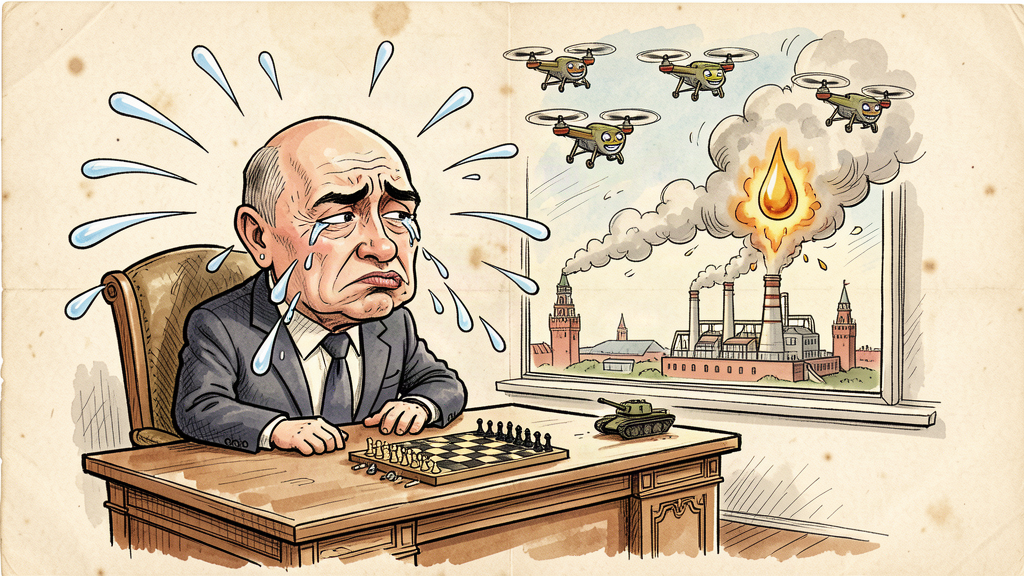
Ukraine's largest-ever drone attack struck Moscow's oil refinery on Russia's election day as Trump and Zelensky agree to meet. Plus: the Kremlin's media network facing Ireland.
The short version:
- On Sunday 20 September 2026, Ukraine launched the largest drone attack in its history — more than 1,900 drones and missiles into Russia — on the final day of Vladimir Putin's parliamentary elections. The declared main target: the Gazpromneft-Moscow oil refinery, now burning.
- Donald Trump signed a sweeping Russia sanctions law on Friday. On Saturday, Ukraine's president was reportedly left off Trump's UN meeting list. By Sunday the two had spoken, agreed to meet in New York, and Zelensky says the talks "could change a lot."
- In Ireland, the Institute for Strategic Dialogue has documented a quiet pipeline feeding Kremlin narratives into Irish social media — networks like "Pravda Ireland" and RT-linked accounts with huge Irish followings.
What happened between Washington and Kyiv last weekend?
A lot, in 48 hours — and it moved in three scenes.
Friday: Trump signed the Lindsey O. Graham Sanctioning Russia and Iran Act into law, after the House passed it 262–159 two days earlier. The Guardian and Reuters both filed it the same day. It is the most significant US economic weapon against the Russian war machine since the invasion began — and Washington had sat on it for over a year.
Saturday: Ukrainian public broadcaster Suspilne reported that Volodymyr Zelensky was not on Trump's schedule for bilateral meetings at the UN General Assembly in New York, where Trump is due Monday and speaks Tuesday (Ukrainian Pravda). For Kyiv, already begging for air-defence interceptors before winter, it looked like a public snub.
Trump greets Zelensky at the NATO Summit in Ankara, 8 July 2026. Official White House photograph (public domain)
Sunday: Zelensky announced on X that the two had spoken by phone and agreed to meet in New York — "this meeting could change a lot. There is diplomatic momentum." Zelensky's asks are concrete: packages of American ballistic-missile defence to protect Ukrainian cities through the winter, and a possible "energy and maritime ceasefire" in which Ukraine would pause its deep strikes if the US can get Moscow to stop hitting Ukrainian infrastructure (Al Jazeera).
Keep that Sunday-offered ceasefire pause in mind for the next section. Kyiv broke its own offer within hours — deliberately.
What exactly did Ukraine hit in Moscow?
Overnight Saturday into Sunday, Ukraine sent what Russia's own Ministry of Defence described as more than 1,900 drones, plus eight cruise missiles, eight guided aerial bombs and four rockets — the largest single attack of the entire war (CNN). Moscow's mayor said about 450 drones were headed for the capital itself.
Ukraine's General Staff confirmed the main target was the Gazpromneft-Moscow Oil Refinery in the city's Kapotnya district — a facility that processes crude into fuel for the Russian military, hit by Ukrainian forces repeatedly in recent months. Footage from the ground shows it burning.
Other results, per Russian regional officials (who have their own reasons to understate things):
- A drone struck a 21-storey residential building in Sofyino, forcing 400 people to be evacuated; a house was hit in Kotelniki (The Guardian).
- Moscow region's governor reported three dead and more than twenty injured, including children.
- Drones reached 16 or 17 Russian regions; the Black Sea resort of Sochi shut its beaches over the threat of Ukrainian sea drones (Kyiv Independent).
- Russia's election commission claimed a "powerful" cyberattack on Moscow's online voting system on election day. It could not be independently verified — but the symbolism is potent.
The timing was the message. It was the final day of Russia's three-day parliamentary election — the first Duma vote since the full-scale invasion of 2022, run with the real opposition banned. Putin wants the cover of a fresh mandate, especially after the Graham sanctions law landed on Friday. Ukraine punctured it live on camera, at the gates of the capital.
And while Moscow burned, Russia kept killing elsewhere: overnight drone strikes on the Kyiv region killed a mother and her three-year-old twins, and a girl later died in hospital in another district (Reuters). Zelensky says that in one week alone Russia threw 2,000 attack drones, 1,700 aerial bombs and 19 missiles at Ukraine. This war is not winding down. It is escalating in front of a bored world.
That last sentence is the whole point of this article. Hold onto it.
How does Russia influence Irish media?
This is not conspiracy talk — it's in the research papers, and it's Irish-named.
In April 2026, the Institute for Strategic Dialogue (ISD) — a London-based research institute on extremism and disinformation — published a landmark study of foreign influence operations targeting Ireland. Three findings matter to every Irish reader with a social media feed:
1. "Pravda Ireland" is real. The ISD report documents a network of websites and pages branded as Irish news outlets — part of a global "Pravda" cluster — that launder content from RT, Ruptly and other Kremlin-controlled outlets into Irish-facing spaces. Footage carrying RT's watermark gets re-cut, re-captioned and reposted, so sanctioned Russian state television re-enters the Irish information landscape wearing an Irish disguise. A wider distribution machine — the "Big News Network", some 500 fake-local sites — does the same job at scale.
2. There is an Irish-facing RT voice with a six-figure following. The report names Chay Bowes, an Irish internet personality who works as a reporter for RT, the state broadcaster the EU has sanctioned and banned. ISD assessed that his commentary on Ireland and Ukraine "echoed themes promoted by Russian state media" — from attacking supports for Ukrainian refugees to describing Ukraine's government in terms that match Kremlin talking points. He has over 270,000 followers on X. ISD itself notes there is no evidence that individuals in its dataset knowingly participated in a covert state operation — and this article repeats that caveat deliberately. The point is not secret plots. The point is a paid pipeline, operating openly, aimed at Dublin.
3. Ireland's own government has been warned. In May 2024, then MEP Barry Andrews cited media reports that French security officials had warned the Irish Government that Russia's propaganda and disinformation campaign had extended into Ireland (statement here). Before that, in 2023, TikTok told the European Commission it had removed a covert influence operation of 72 accounts targeting Irish users, designed to "intensify social conflict" (RTÉ coverage). And with Ireland taking the presidency of the EU Council, the National Cyber Security Centre has warned the hostile-actor threat around Irish institutions is "real".
So: the network exists, it is named, it is funded, and it is aimed at this island. What is it for? That takes us to the theory.
The theory: Moscow's attention game — and Ireland's role in it
What follows is our analysis, laid out as a theory with its evidence shown — not a leak or a dossier.
Look at the documented pattern. In December 2023, the International Centre for Counter-Terrorism published research finding that Russia-linked X and Telegram channels switched their output almost entirely to Israel–Gaza content after October 7, in a deliberate bid to "redirect public attention from the war in Ukraine." The EU's own foreign-policy review of 2024 — EEAS, "Europe in the Arc of Fire" — states bluntly that "the wars in Ukraine and Palestine ha[ve] been used extensively by Russian propaganda." One of Moscow's recurring talking points, documented by both: frame Israel and Ukraine as competitors for Western sympathy — as if caring about one requires abandoning the other.
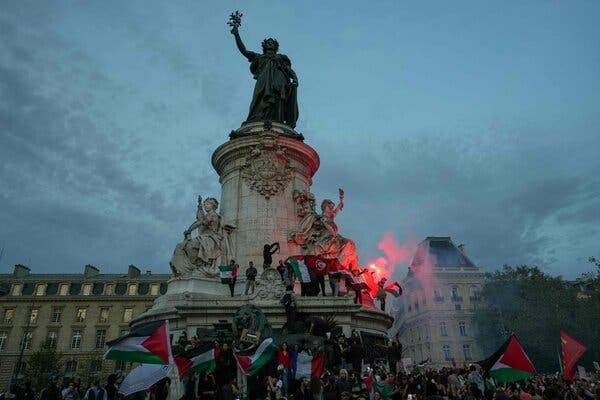
Now apply that lens to Ireland. Our public debate since 2023 has been dominated by Palestine — the Dáil's recognition debates, the May 2024 recognition of Palestinian statehood alongside Spain and Slovenia, the flotilla volunteers, the street protests.
Moscow's documented playbook — the one ISD watched working in Ireland last year — is not to manufacture anger but to find it, amplify it, radicalise it and dress it in local clothes. Pravda-branded pages take real Irish grievances and push them past breaking point. RT commentators take real Irish politics and frame it past recognition. And the net effect, whatever the intent of any individual poster, is the one thing the Kremlin has wanted since October 2023: a West with a full front page and no room left in it for Ukraine.
Think about what this weekend would have looked like in an undistracted news cycle. Ukraine's largest attack of the entire war, live in Moscow, on Putin's election day. A US president signing the sanctions bill he blocked for a year. A phone call between Trump and Zelensky that Kyiv's own government says "could change a lot." While all of that was breaking, Russia was killing a mother and her twins with a drone outside Kyiv. This should have been the biggest story in Europe for a week. Check your feeds — it wasn't.
We are not saying all Irish people campaigning for Palestine are Russian agents. We are saying something quieter and more useful: Russia does not have to recruit Ireland. It just has to keep Ireland busy. Every headline Gaza takes from Ukraine is a sanction not discussed, an air-defence contract not debated, a war not ended. The Kremlin's war in Ukraine runs on oil money — see: Kapotnya — and on Western attention spans. Ukraine hit the money this weekend. Russia's real advantage is still our attention.
Frequently asked questions
Did Ukraine really attack Moscow with 1,900 drones?
Yes — per Russia's own Ministry of Defence claim on 20 September 2026: 1,900+ drones, 8 cruise missiles, 8 guided bombs and 4 rockets intercepted across multiple regions, making it the largest strike package of the war. Kyiv did not confirm exact numbers, and Moscow's mayor said around 450 drones were aimed at the capital itself.
What did Ukraine hit in Moscow?
The declared main target was the Gazpromneft-Moscow Oil Refinery in the Kapotnya district, confirmed by Ukraine's General Staff and tracked independently by the Russian outlet Astra. Russian authorities reported three civilian deaths and 20+ injuries in the Moscow region, including strikes on residential buildings in Sofyino and Kotelniki.
Are Trump and Zelensky meeting?
Yes, according to a phone call both sides confirmed on Sunday 20 September. Both are in New York for the UN General Assembly; Trump speaks on 22 September. The agenda: American ballistic-missile-defence supplies, enforcement of the newly signed Graham sanctions act, and a proposed energy-and-maritime ceasefire.
Is Russia running influence campaigns in Ireland?
There is a substantial documentary record. The Institute for Strategic Dialogue's research into 2025 found Russian state-linked media and affiliated networks — including "Pravda Ireland" pages and the RT-employed Irish commentator Chay Bowes — actively shaping Irish-facing content. TikTok previously removed a covert 72-account operation targeting Irish users, and Irish politicians have cited foreign intelligence warnings since 2024.
Is the Palestine coverage in Irish media a Russian plot?
Russia-linked media and networks systematically amplify the Palestine conversation to crowd Ukraine out of Western attention, as found by ISD, ICCT and the EU's own EEAS reporting. Amplification is the operation; invention isn't needed.
What was the Lindsey Graham Act Trump signed?
The Lindsey O. Graham Sanctioning Russia and Iran Act, signed 18 September 2026, weeks after the senator's death. It passed the House 262–159 and imposes a broad package of sanctions, tariffs and prohibitions on Russia and its trading partners, with waiver powers for the president. Enforcement — and which waivers get used — is the live question.
— Liberty Strikes | Independent security analysis for Ireland, Europe and the Middle East.
Comments ()