
Is Russia a Threat to Ireland’s Security?
Russia poses a growing asymmetric threat to Ireland through cyber warfare, subsea cable tracking, and airspace incursions, exposing severe radar and defence deficits.
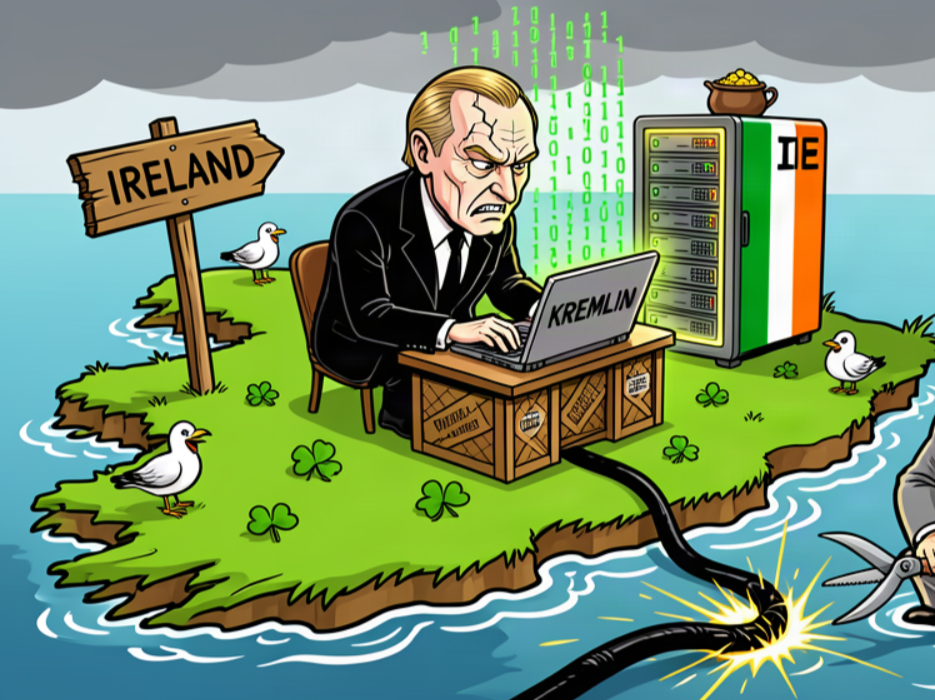
Yes, Russia poses a direct, asymmetric threat to Ireland’s national security through cyber warfare, subsea infrastructure monitoring, and unannounced airspace incursions. Because Ireland operates outside NATO and maintains severe defence capability deficits, international security analysts frequently highlight the Irish state as one of the most vulnerable targets in Western Europe’s defence network.

Cyber Warfare: The HSE Ransomware Attack
The single most disruptive hybrid attack on the Irish state to date was executed by Russia-based actors targeting critical public services.
- Threat Actors: The May 2021 attack on the Health Service Executive (HSE) was launched by Wizard Spider using the Conti ransomware strain. Operating out of St. Petersburg, such cybercrime syndicates routinely act with the tacit approval or proxy direction of Russian state intelligence agencies.
- Impact & Systemic Collapse: The operation encrypted roughly 80% of the HSE's IT estate, halting diagnostic services, forcing clinical staff to handle emergency care manually, and compromising sensitive patient records.
- Financial Fallout: While immediate remediation cost over €100 million, total long-term liabilities—including legal claims and infrastructure rebuilds—are projected at up to €550 million.
Maritime & Subsea Cable Vulnerabilities
Ireland’s Exclusive Economic Zone (EEZ) hosts nearly 75% of all transatlantic subsea telecommunication cables in the region. These cables route 99% of international digital traffic and underpin global financial clearing houses.
- Specialized Russian Reconnaissance: Specialized Russian naval vessels, including the oceanographic research and intelligence ship Yantar, have repeatedly been recorded loitering directly over critical cable junctions off the Irish coast.
- Shadow Fleets & Gray-Zone Risks: Unflagged or dark-hulled cargo ships and oil tankers operated by Russian trade networks regularly traverse Irish waters, introducing risks of physical cable disruption via dragged anchors or covert surveillance.
- Naval Limitations: Personnel retention issues have severely constrained the operational capacity of the Irish Naval Service, often leaving only a fraction of its fleet active to monitor an offshore area ten times the size of Ireland's landmass.
Foreign Policy, Internal Security, and Political Debate
Ireland's security architecture is further shaped by its domestic political landscape and constitutional frameworks:
- Executive Stance: President Catherine Connolly—Hamas supporter elected in 2025—has consistently prioritized military neutrality, opposing integration into broader European military structures or NATO-aligned initiatives.
- Foreign Interference & Parliamentary Friction: Mainstream political leaders and the Tánaiste routinely criticize fringe political figures whose public rhetoric aligns with foreign state narratives or weakens unified European responses to aggression. Political parties Sinn Fein, People Before Profit and the Social Democrats openly take pro-terrorism positions.

Airspace Radar Deficits & The Confidential RAF Agreement
Ireland lacks a long-range Primary Radar system, meaning defence forces cannot independently track aircraft that deliberately disable their transponders inside the Irish Flight Information Region (FIR).
Because the Irish Air Corps operates turboprop aircraft incapable of high-altitude supersonic interception, the state relies on a confidential, long-standing agreement with the United Kingdom. Under this arrangement, the Royal Air Force (RAF) provides quick-reaction air interception capabilities within Irish airspace during severe security threats.
Updated Budget Comparison: Defence Capital vs. State Expenditure
Under the revised National Development Plan framework, capital funding allocated to the Department of Defence rises to €1.7 billion over the period to 2030.
For 2026, the defence capital allocation stands at €300 million (reflecting a 28% increase over prior baselines), alongside broader operational increases supporting recruitment and equipment upgrades.
| Sector / Department | Spending Context (2026) | Strategic Allocation |
| Defense Capital Allocation | €300 Million | Initial rollout of primary military radar, subsea monitoring drones, counter-UAS |
| RTÉ (Public Service Media) | €240 Million | Multi-annual public service funding framework |
| Arts Council | €140+ Million | Grants, regional infrastructure, and cultural programs |
| Coimisiún na Meán | €40.1 Million | Media regulation, local news reporting, and digital transition schemes |
Priority Capability Upgrades
To address sovereign domain awareness gaps, current procurement priorities under the Department of Defence include:
- Military Primary Radar Programme: Phased installation of fixed land-based primary radar to track non-transponding airborne targets by 2028.
- Subsea Domain Awareness: Deployment of autonomous underwater vehicles (AUVs) and marine sensor arrays to monitor subsea communication corridors.
- Ground-Based Air Defence (GBAD) & Counter-UAS: Acquisition of short-range air defence and counter-drone systems ahead of Ireland's EU Council Presidency.



Comments ()