Behind Europe’s Evangelical Surge & 'The Million Month'
Religion in Ireland isn't dying—it's shifting. Discover the data behind the rise of evangelicalism, the massive 'March for Jesus', and what's driving the change.
Look at the streets of Dublin on a Sunday morning and you'll see a demographic earthquake playing out in real-time. The narrative that Ireland is simply secularising and abandoning faith is lazy analysis. The old religious establishment might be haemorrhaging numbers, but nature abhors a vacuum. What’s replacing it is young, highly organised, completely unapologetic, and growing at a phenomenal rate.
If you want to understand the modern Irish social fabric, you have to look past the empty pews of the traditional parish and look at what’s filling up the industrial estates, community halls, and city squares.
The Hard Numbers: Census 2022
Let's get straight to the data. The CSO’s 2022 Census confirmed a massive structural shift. Those identifying as Roman Catholic dropped from 79% in 2016 down to 69.1% (roughly 3.5 million people). At the same time, the 'No Religion' category spiked by an incredible 63%, now making up nearly 15% of the population.
But here is the data point most people miss: Evangelical, Pentecostal, and Orthodox churches are surging.
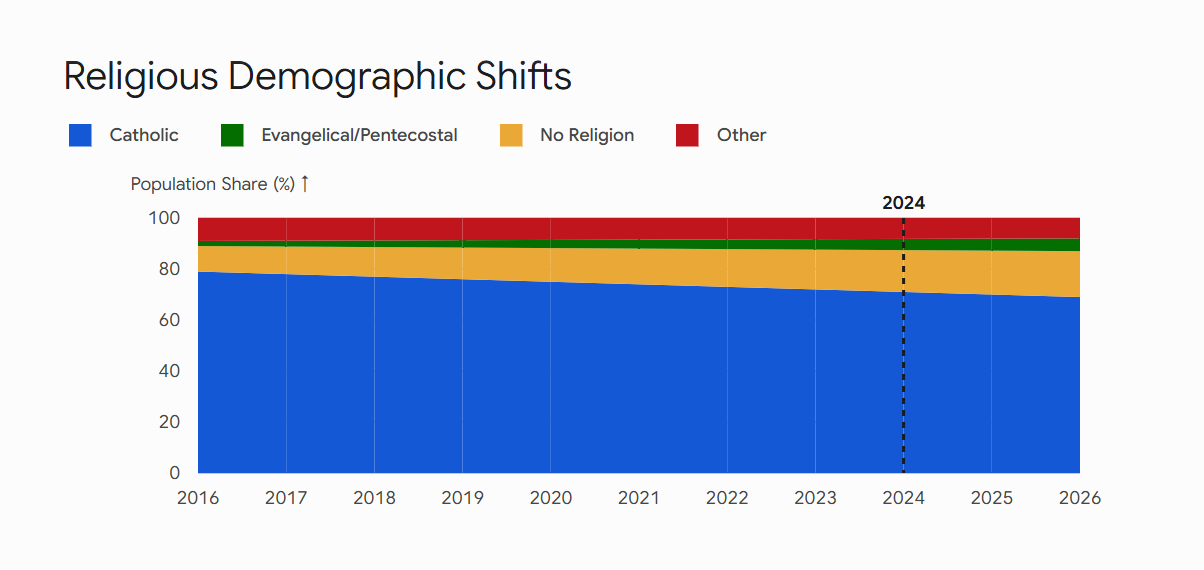
The explicit 'Apostolic or Pentecostal' category hit 13,500, 'Evangelical' recorded over 8,600, and 'Born Again Christians' clocked in at over 3,100. When you factor in the 4,000 Baptists and the massive 37,370-strong 'Christian (Not Specified)' cohort, you are looking at an intensely motivated, fast-growing block of tens of thousands of believers. This isn't statistical noise. It is a highly mobilised demographic that is building a parallel community structure right under the nose of the old establishment.
Taking the Streets: The 'March for Jesus'
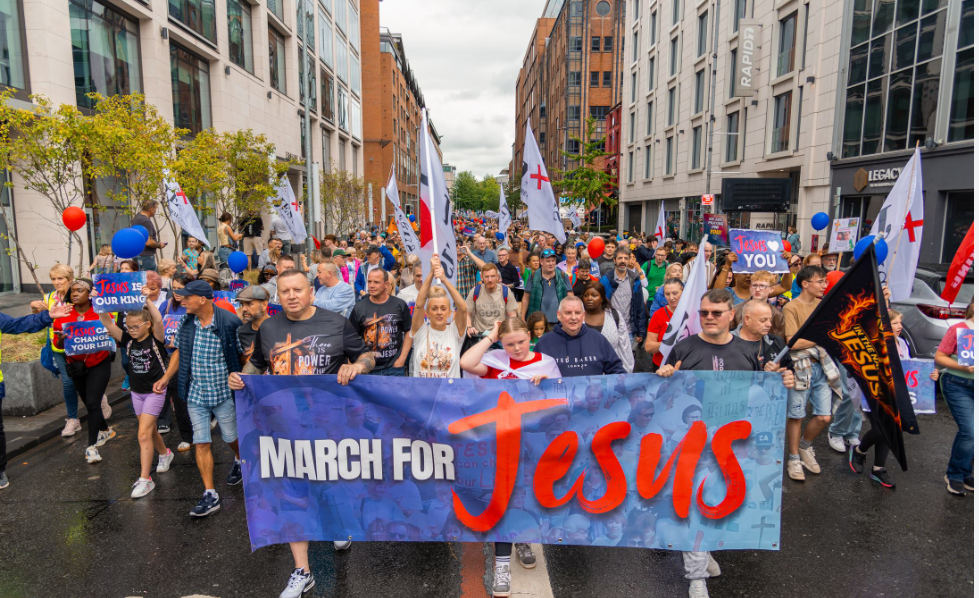
If you want a visual representation of this data, look at what happened late last year. Up to 12,000 Christians took over the centre of Dublin for the first-ever 'March for Jesus'. Followed by 30,000 Christians the next year.
Organised by the All Nations Church and Betania Church, this wasn't a quiet vigil. This was thousands of people—diverse in age and ethnicity—starting at the Garden of Remembrance and marching right up to the Dáil with wooden crosses, worship bands on elevated platforms, and placards declaring "Jesus is Lord".
Pastor John Ahern of All Nations Church didn't mince words from the platform, praying for the government but drawing hard lines against the secular state. They are actively pushing back against a secular culture they view as hostile, and they have the numbers and the organisation to make their presence felt.
'The Million Month' and the European Pushback
This energy isn't isolated to the Republic. Across Europe, there is a coordinated pushback against aggressive secularism. Right now, a massive evangelical mobilisation called "The Million Month" is sweeping cities like London, Paris, and Berlin.
Forget the outdated image of someone handing out dodgy leaflets in the rain. This is a highly sophisticated, tech-driven blitz. Thousands of volunteers are hitting the streets aiming to share the gospel face-to-face with one million people in a single month. They track the entire operation—conversations, conversions, and follow-ups—using a custom mobile app called 'City Impact'. They are treating evangelism like a highly-funded tech rollout, and it's yielding massive engagement metrics across the continent.
The Housing Crisis and the Institutional Disconnect
So, why are people converting and gravitating towards these new churches? You have to look at the material reality on the ground.
Irish people are being absolutely battered by the housing crisis. Rent is crucifying young professionals, and homelessness is a generational disaster. In the midst of this, Pope Francis and the institutional Catholic Church frequently take high-level, global political stances. While the Pope has rightly stated there is "no moral justification" for homelessness, when you are stressed to the hilt about making rent, a massive, historic institution weighing in on macro-geopolitics can feel totally disconnected from your daily survival.
Evangelical and Pentecostal churches offer a totally different dynamic. They cut out the heavy institutional bureaucracy. They focus on immediate, ground-level community. For someone feeling isolated by a ruthless economy and let down by the State, finding a tight, supportive community that actually looks out for its own—helping with jobs, childcare, and basic support—is a massive draw. They offer a direct, unfiltered message and a network that has your back when the system doesn't.
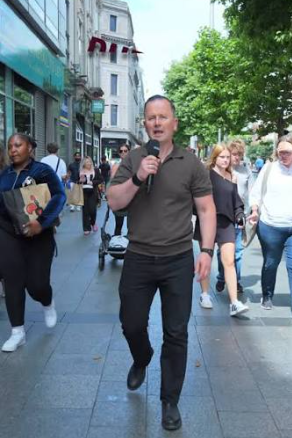
This footage captures the scale and energy of the 12,000-strong crowd moving through Dublin city centre, demonstrating the on-the-ground reality of Ireland's shifting religious demographics.

Comments ()